



Portugal is a country that captivates through every sense. Picturesque sights abound, from medieval villages to coastal cliffs. Even in epicenters like Lisbon, its capital, life is more romantic than usual: people still travel by tram, savor delicious custard tarts, and stroll through streets decorated with beautiful tiles. Of course, behind those beautiful postcards, there’s a soundtrack. That can be a great gateway to immersing yourself in Portugal’s vibrant music scene. And for this journey, we have a top-notch musical guide: Janeiro, a talented singer-songwriter and exquisite producer, endowed with the kind of appreciation and sensitivity needed to provide a musical panorama. An invitation to the sonic intersections of this unique culture, driven by the still-present traditional roots of fado, the organic influence of African rhythms, and a constant desire for modernization.
“The current music landscape in Portugal is vibrant, but fragmented,” Janeiro initially describes, as an overview. “There’s a lot of quality, but not enough connection between scenes. Lisbon is a creative hub, but incredible movements are happening up north, in the interior, and on the islands. Portugal is small, but its music is vast.” The country’s capital, Lisbon, is presented as the focal point of music: it’s where all artists aim to reach their peak. However, other regions also resonate. “Lisbon is still the industry’s center, but Porto has a very distinct creative force — rawer, more alternative”, he points out, venturing to geographically outline what sounds and is heard. “Then there are surprising pockets of music outside the big cities: amazing projects emerging in Évora, Leiria, the Azores. The map is slowly decentralizing — and that’s a very good thing.”
Each scene has its own movement, expanding or contracting. And for each scene, there are names to highlight, according to taste or significance. Janeiro, of course, has its chosen ones. “In folk, I’d mention B Fachada and Emmy Curl”, he says. Bernardo Cruz Fachada, better known as B Fachada, is a singer-songwriter from Lisbon with a 20-year career and an extensive discography. Among his many collaborations, B Fachada was part of the early years of Diábo na Cruz, a rock band that successfully integrated elements of traditional music into their sound, such as the viola braguesa. Catarina Miranda, known by her stage name Emmy Curl, is a singer-songwriter originally from Vila Real, in the northeast region of Portugal. Active since 2007, she has released five albums, not counting several EPs and singles. With a clear tendency toward layered vocals, her songs unfold like seas of melodies, but are also often intrinsically rhythmic, blending acoustic and electronic sounds.
As for the new voices in pop music, Janeiro doesn’t hesitate to highlight the female advance, pointing to three girls who enchant with their sweet singing: Maro, Iolanda, and Carolina Deslandes. Mariana Brito da Cruz Forjaz Secca, known professionally as Maro, is a Portuguese singer-songwriter with a privileged voice, one of those that can touch hearts. She studied at Berklee College of Music in Boston and settled for a time in LA to kick-start her musical career. In 2018, she released a series of albums, which gave her international exposure and the chance to open for Jessie J. In 2022, she participated in the Festival da Canção, where her song “Saudade, saudade” was crowned to represent Portugal in the Eurovision Song Contest (she reached the semi-finals and placed among the top 10). In 2023, Maro released Hortelã, an album recorded with Spanish guitarists Pau Figueres and Darío Barroso. She also performed with them at the Tiny Desk Concert that same year.
Also a participant in the Festival da Canção, Carolina Deslandes has a career more akin to that of a pop star: she emerged from the TV reality show Idolos in 2010 and became a prominent coach for The Voice Portugal from 2021 to 2023. In between, of course, she released three studio albums and had many hits. Iolanda Costa, known simply as Iolanda, followed a similar path. Originally from Figueira da Foz, a city in the Coimbra district, she began appearing in talent shows in her early teens. She moved to Lisbon to attend university and continue trying her luck in television contests. She then traveled to London to study music. In 2022, as a more mature artist, she began releasing her songs and debuted at the Festival da Canção, where she was crowned in 2024 to enter the Eurovision Song Contest.
Another artist who won the Festival da Canção, and thus represented Portugal at the Eurovision Song Contest, is Tiago Miranda, known by his stage name Conan Osíris. This recognition came in 2019, thanks to his acclaimed song “Telemóveis”, which reached YouTube and Spotify trends. But his career doesn’t start there, not at all, since between 2011 and 2017 he released four albums. Originally from Lisbon, this singer-songwriter claims to have taught himself music, using only his computer. The result is an enigmatic and hard-to-label alternative pop, with elements of fado, techno, gypsy, and Arabic music.
“Artists like Conan Osiris or Pedro Mafama have shown that Portuguese songs can also sound futuristic”, says Janeiro, citing some names that he considers marked a before and after in the renewal of Portuguese song. An artist like Pedro Mafama — the alias of Pedro Simões — couldn’t be missing here. A singer-songwriter from Lisbon and a new sensation in Portuguese music, his captivating approach blends traditional song with electronic sounds and aesthetics rooted in today’s urban culture, also drawing on avant-garde and powerful stage drama. There’s a reason some call him the Portuguese C. Tangana, although his musical narrative is quite unique. Partnered with renowned singer Ana Moura, Pedro has released two EPs and two studio albums between 2017 and 2023.
Of course, there are older singer-songwriters who represented a major turning point in the history of Portuguese song. Janeiro’s list begins with a troubadour who is invaluable at this point: José Afonso, also known as Zeca Afonso. With more than 20 albums, not counting posthumous works and tributes, this singer-songwriter from Aveiro is primarily remembered for his highly popular song, “Grândola, Vila Morena”, the anthem that started the Carnation Revolution on April 25, 1974, and was later reused for the soundtrack of the hit Netflix series Money Heist. Another turning point is Porto-based singer-songwriter and poet Sérgio Godinho, with a vast discography, including some gems from the early 1970s that were once censored. Janeiro also includes Fausto Bordalo Dias, known simply as Fausto, a singer-songwriter and cultural executive who left behind an admired musical output, especially during the 1970s and 1980s. Fausto was born during a sea voyage between Portugal and Angola, was registered in the Guarda district, and died last year in Lisbon.
Another milestone in the evolution of Portuguese song is Claudino Jesús Borges Pereira, better known by his stage name Dino D’Santiago. The son of Cape Verdean parents, this singer-songwriter and activist was born in Quarteira, a civil parish located in the Algarve, the southernmost region of Portugal. Between 2008 and 2012, before releasing albums as Dino D’Santiago, he played in several R&B, soul, and hip-hop bands — he was a member of Nu Soul Family, collaborated with Extensive Soul, and had his own project, Dino & The Soul Motion. His debut solo album, Eva, was named one of the world’s best albums of 2013 by the Europe World Music Charts jury. “Dino is proof that everybody wants to listen to sick beats with juicy, activist lyrics and be incredibly cool at the same time”, says Janeiro.
Portuguese electronic music also experienced its turning points, especially thanks to Buraka Som Sistema, a band active between 2006 and 2016, credited with creating progressive kuduro. Similar to kizomba, kuduro’s beat is characterized by being fast, energetic, and danceable. It developed in Luanda, Angola, in the late 1980s, when some ghetto kids began sampling traditional carnival music such as soca and zouk béton, fusing it with techno. It means “hard ass” in Angolan slang. While kuduro was their specialty, Buraka Som Sistema also dabbled in breakbeat, grime, moombahton, and raptor house. They released four albums between 2006 and 2014, and rocked festivals like Glastonbury, Roskilde, and Sónar. In 2008, they were voted “Best Portuguese Act” at the MTV Europe Music Awards. “Buraka Som Sistema changed the rhythmic and aesthetic paradigm”, Janeiro notes.
Inspired by both Portuguese song traditions and Brazilian popular music, Janeiro has forged a path where electronica also has its place, whether as rhythm or texture, coexisting with organic sounds. All this to say that he knows the electronic music scene. He immediately mentions DJ Nigga Fox, the stage name of Rogério Brandão, a Portuguese international producer born in Angola. He also highlights Sensible Soccers, a trio from northern Portugal with a landscape electronic approach that is as hypnotic as it is enchanting. Another key name is Branko, a Lisbon DJ and producer who became known as part of Buraka Som Sistema. Of course, Janeiro has more recommendations: “I love the curatorial sensibility of Xinobi. I’m into STCKMN’s emotional electronic sets. And DJ Marfox remains a reference when it comes to Lisbon’s rhythmic identity. PEDRO is incredible”.
“I’ve always felt like I existed between worlds”, says Janeiro to try to find his place in the local music scene. “Not quite a pop singer, not quite an experimental artist. But I think I belong to a scene that blends songcraft with electronics, tradition with risk, and that’s not afraid to try new things. I feel now that I’m expanding the scene to a new form of artists that didn’t exist before here: blending everything. Poems with surrealistic videoclips, mixed with portuguese songs and good electronica to dance but to think too”. At the intersections between traditional and modern, as he points out, a refreshing fusion between folkloric roots and electronic experimentation is also possible.
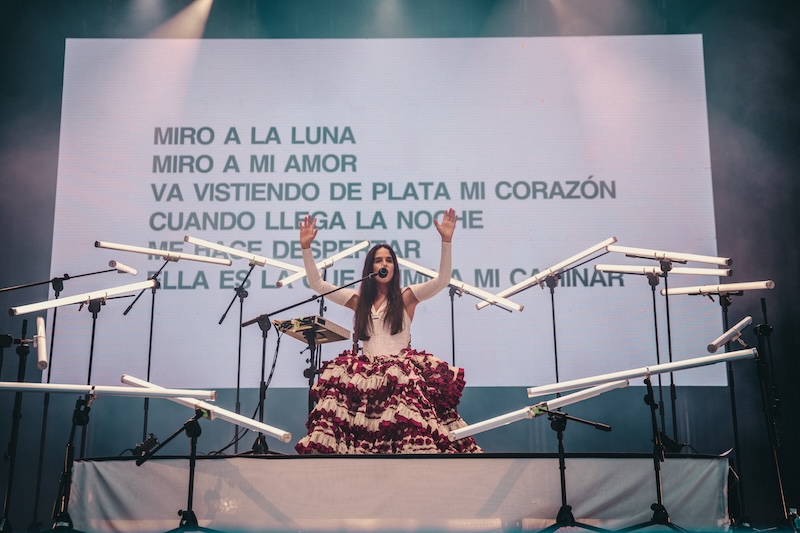
It is precisely at these crossings that Janeiro detects the talent of an artist like Ana Lua Caiano. A singer-songwriter and producer, she considers herself a one-woman band that explores traditional elements of Portuguese music with a modern approach, incorporating electronic music and hip-hop. Her style is captivating, and her lyrics reflect personal and social experiences. Last year was eventful for her, from being invited to join the lineup of festivals like Primavera Sound to perform for KEXP and A COLORS SHOW.
Another artist Janeiro brings out in these intersections is Batida, the alias behind Pedro Coquenão, all-terrain artist born in Huambo, Angola, and raised in the suburbs of Lisbon. His sound swings between electronic and tribal, with a clear intention to restore African roots. And his approach is entirely rhythmic, devotedly danceable (not surprisingly, the word “batida” means “beat” in Portuguese, and is also related to Luanda’s dance culture). Batida is a project that combines music, dance, theater, radio and visual arts.
The music made and heard in Portugal intertwines by its very nature. African root rhythms and traditional music like fado merge organically with modern genres like hip-hop and electronica. There’s such a multicultural richness that permeates every scene. The result is a unique blend of sounds — an intriguing hybrid of Europe, Africa, and the Americas. “A huge influence”, Janeiro says about the impact of fado and other local folklore on more current and global music. “The phrasing, the emotional weight, the modes — all of that can be a goldmine for creativity. The more we tap into our roots, the more universal we can become. I believe in electronic music that carries saudade”. It is precisely this saudade that might encapsulate something of the spirit of Portuguese music. An untranslatable word, “saudade” expresses a primary emotional feeling, close to melancholy, stimulated by the temporal or spatial distance from something beloved and implying the desire to resolve that distance.
Portuguese and African roots music aren’t the only things that permeate the local scene. Brazilian music does it too. Actually, the majority of Portuguese-language music heard around the world comes from Brazil (note that the South American country’s population is 212 million, while the European country’s is less than 11 million).Both countries share more than just their language: there’s an exchange that extends to their musical culture. “It’s vital to me”, Janeiro says about his back-and-forth with Brazilian music. “The harmonic lightness of Brazilian music has always moved me. There’s also a creative openness in Brazil that’s still growing here in Portugal. I’ve worked with Brazilian artists before, and I feel there’s so much more to explore in that cultural dialogue. I made two albums with Paulo Novaes, collaborated on Leo Middea’s album, recorded with Tainá, had dinner with Caetano Veloso… Maybe the next step will be to play tennis with Marcos Valle — if he reads this, I’d love to”.