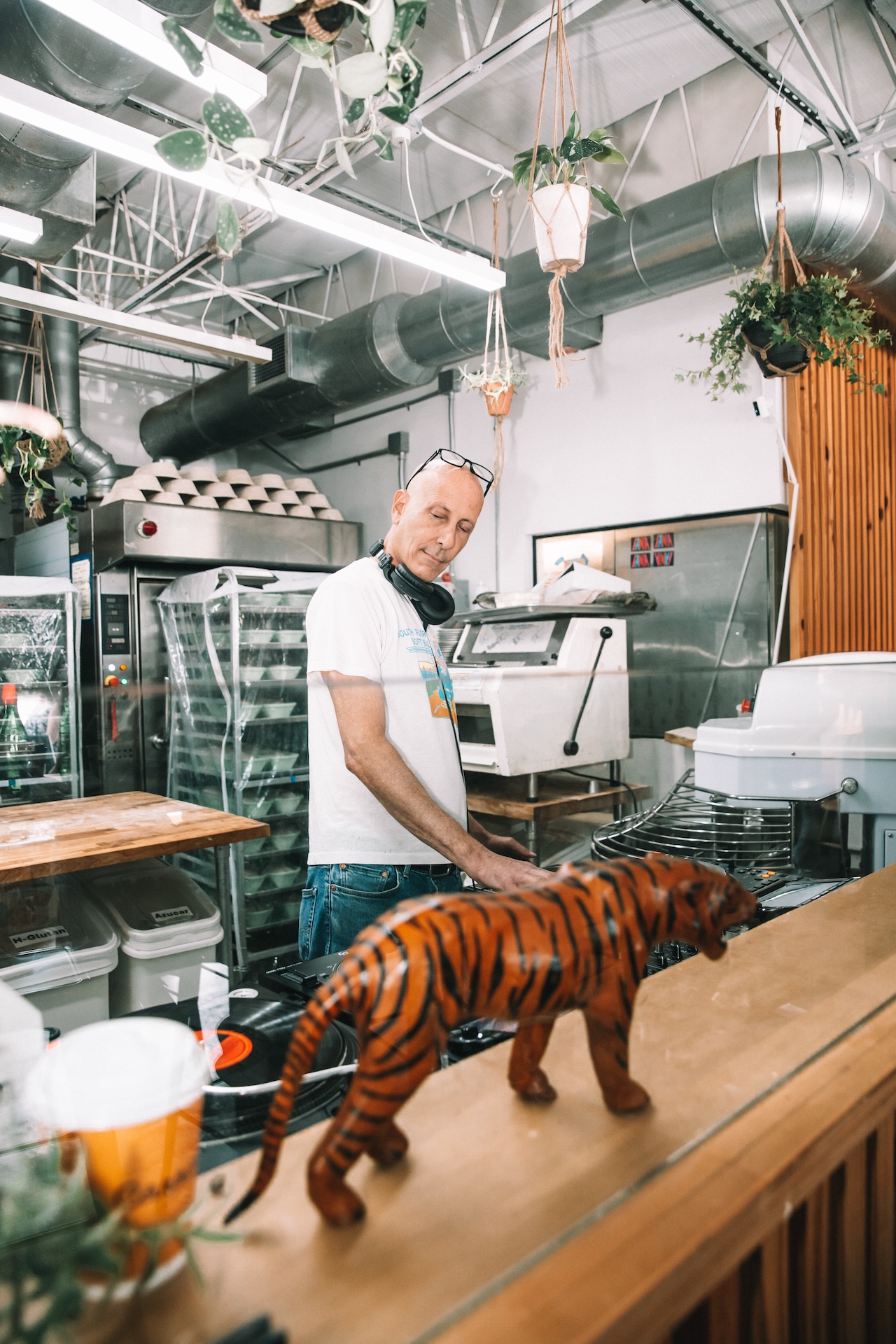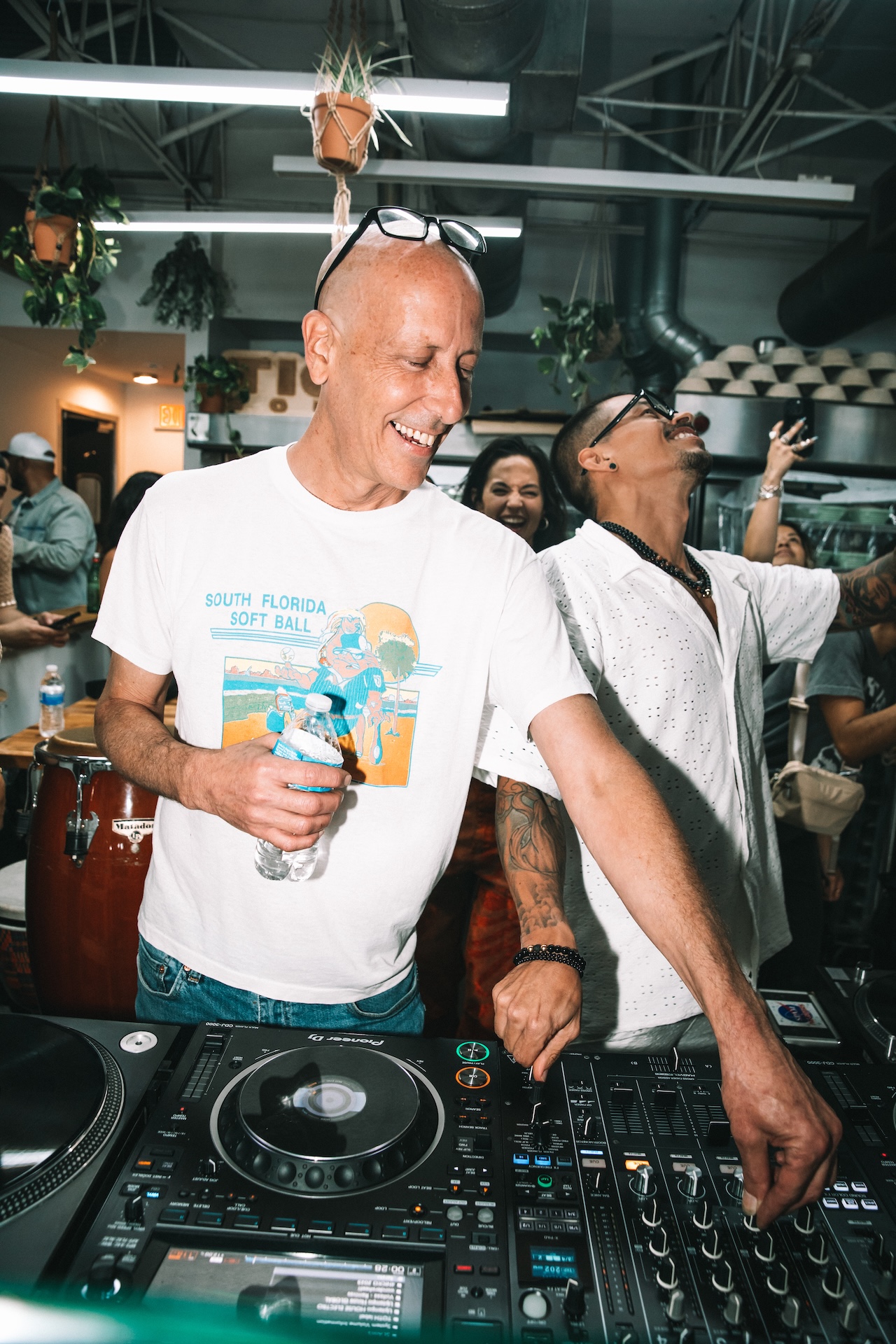




Some people simply transcend their reputation. They take up a larger space than the labels we give them. When it comes to DJ Le Spam, local legend simply does not cut it. For over three and a half decades, Spam has been fully immersed in the Miami music scene, not just as leader of the mighty latin funk outfit The Spam All Stars, but also as a record digger and world-class selector. He is known as one of the city’s elite vinyl collectors and music connoisseurs.
Today, the main bulk of his time is spent in his studio, where he not only records local Miami artists, but also partakes in very important archival work, digitizing master tapes from the catalogs of labels such as J&N (who own the legendary Coco Records).
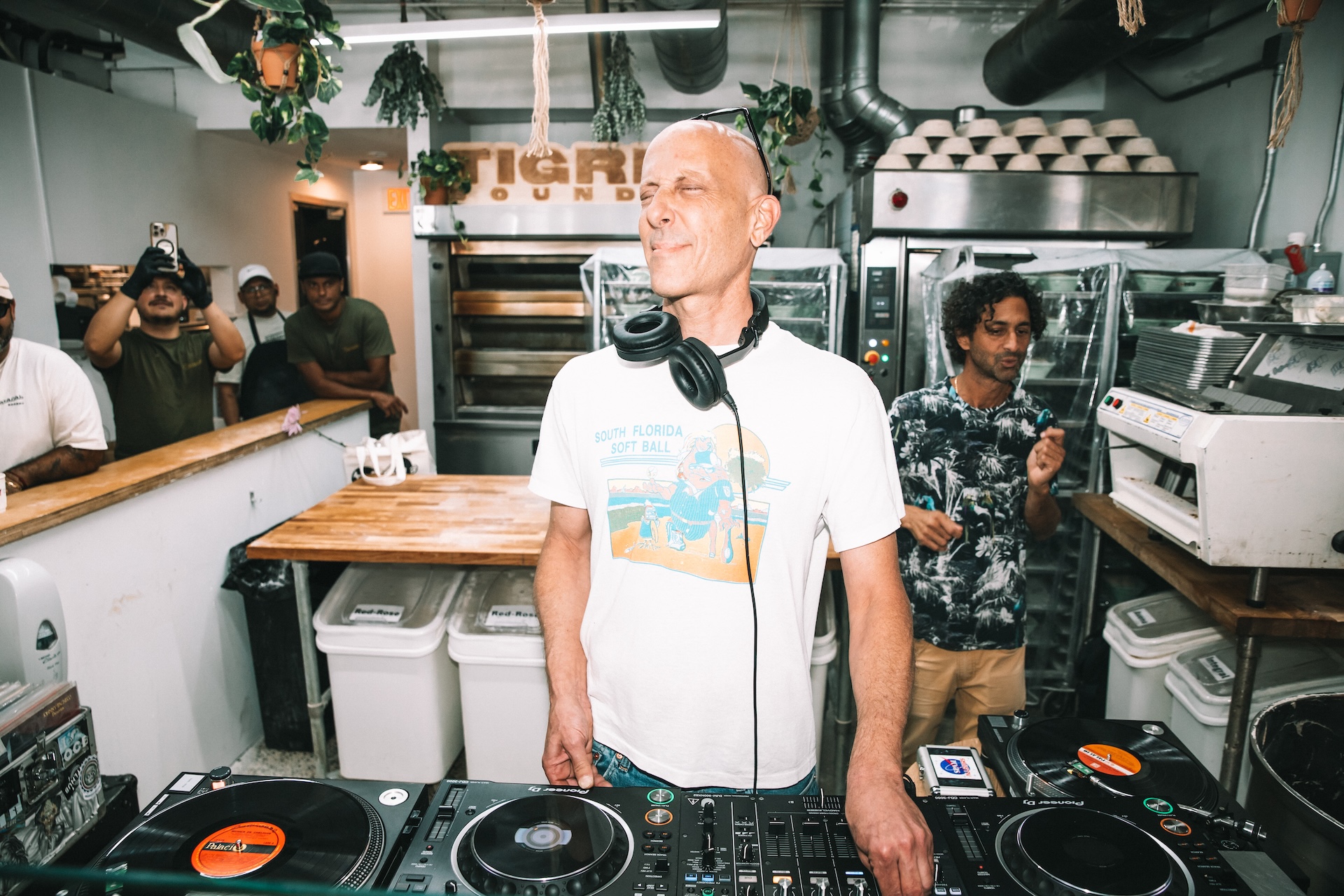
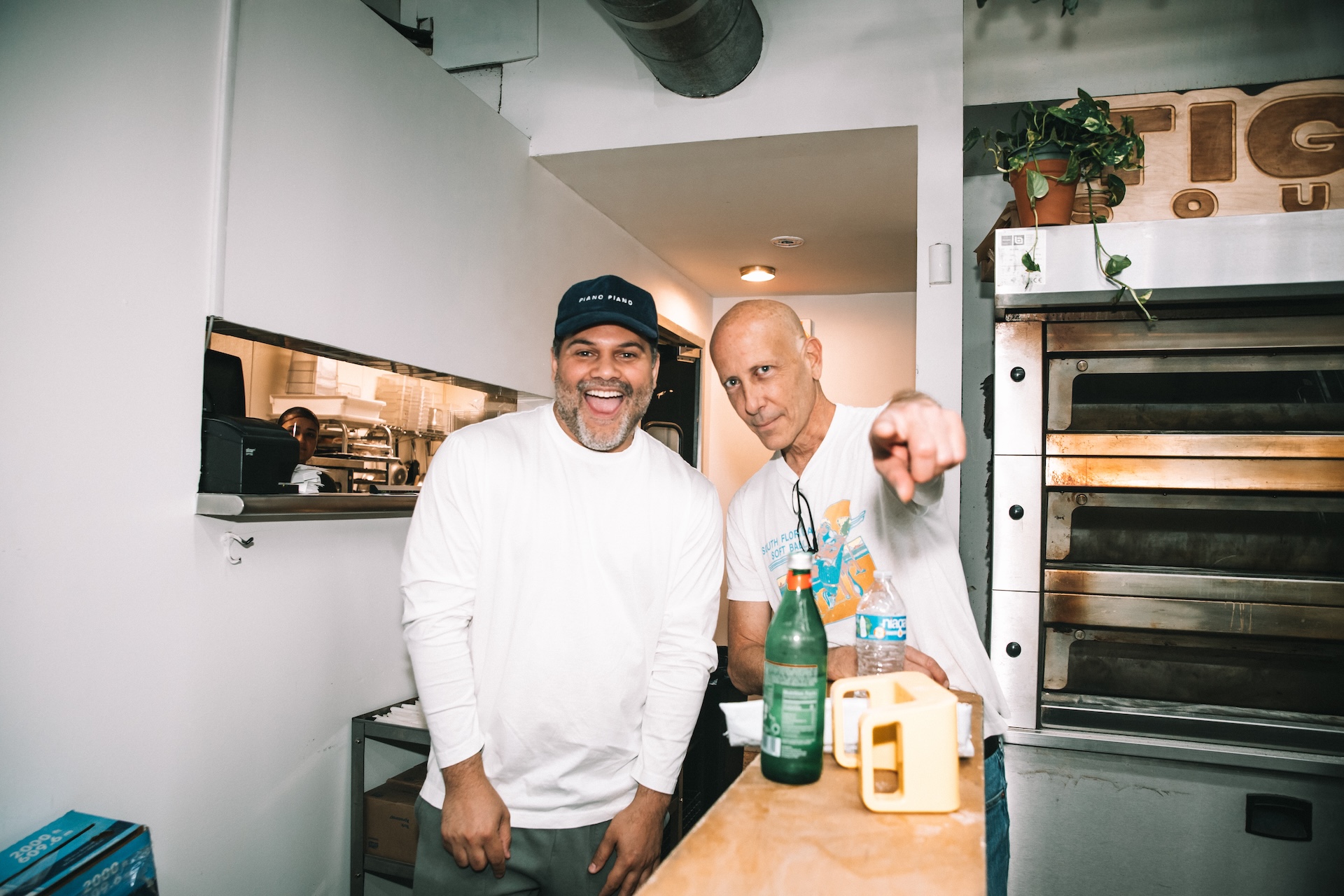
This also means that Le Spam DJ sets are now as rare as the records in his walls, so imagine the joy and privilege it was to see him rock Caracas Bakery at the Tigre Sounds Race Week activation, BPM (Beats Per Mile).
Providing a perfect segway from last month’s Selector playlist, this month’s Tigre Selector, DJ Le Spam welcomes us to El Palacio de La Musica, a deep dive exploration into the musical world of Palacio Records.
Palacio Records was a pioneering and influential Venezuelan record label that played a central role in the development and diffusion of popular music in Venezuela and across Latin America during the mid-20th century. It not only promoted the preservation of Venezuelan folk music such as joropo, gaita zuliana, llaneras, and venezuelan merengue, but it also fully embraced the popular music of the time, releasing albums ranging from salsa, cumbia, bolero, latin rock, latin soul and beyond. Palacio Records was not just a record label—it was a cultural institution. It preserved, shaped, and promoted Venezuelan and Latin American music for generations. Through its contributions, it helped define what it meant to be Venezuelan in a globalizing world, and its legacy continues to influence artists and scholars alike.
After his BPM set, Spam talked to us about the current state of the Miami music scene, his deep love for Haitian music and of course, records.
TIGRE SOUNDS: In the last three decades, you’ve seen Miami change so much. What is exciting for you right now, as far as what’s happening with the city’s growth?
DJ LE SPAM: It’s nice to see that vinyl culture is coming back. You know, there were many years where it was just like me, Safe Stadick, Seam Star, Mr. Brown, and that was kind of it as far as people, we’re talking like pre-2010. And then you would go up to a place where people would be surprised to see you using records. So it’s nice that people are interested and that translates hopefully to audiences where maybe they’re going to be more open to hearing what a selector might bring, and not be so request oriented, so stuff like that, I think is promising. I’m definitely not out there on the streets as I was even seven or eight years ago.
TIGRE SOUNDS: With so many people getting into vinyl collecting, how do you even approach something like that in this day and age?
DJ LE SPAM: Don’t do it! Stop, stop, stop! Stop, while you still can! But seriously, try to get the base collection going in the dollar stores, in the thrift stores, don’t go spending crazy amounts of money.
This is going to upset people and this is like big opinionated shit, but a lot of stuff is getting reissued that doesn’t necessarily need to be getting reissued, and it’s just in order to sell you a product, like, let’s just say Led Zeppelin. We’re talking about a big, huge record, or Thriller, or anything like that. If they’re pressing those records again, while we still have enough left over from the 20th century pressings, which seems like they were better, then we’re over manufacturing again, we’re wasting, you know.
At the same time though, people are doing very small pressings of their own work. So we’re back into this really interesting place where people are making pressings of 1000 units, 500 units, sometimes even less. I’m interested to see what those types of products are going to be worth in like 20 years because those are going to become hyper rare. Those are going to be like the funk 45s that you know of, but even more rare, so it’s just cool. The format’s alive, we have the manufacturing now back, all the links in the chain are back. That’s really good.
TIGRE SOUNDS: What were some of your crazier come ups when you were at your peak digging for records?
DJ LE SPAM: I think it’s still there, but the 79th Street furniture store, which is 79th and Northwest seventh. I think they would get records from storage units that would go on sale. I was going there a lot in the early 2000s and then the guy got to know me, because I would just go through all the records. I would buy hundreds of records at a time. And so then one day I went in and the guy said, “Oh, we got cardboard boxes on the truck that just came in from a storage unit, and they were all taped shut and nobody has gone through them yet.” All the boxes had the guy’s name on it. His name was Pepe from Colombia. Pepe from Colombia bro, this was salsa. It formed the base of my whole salsa collection. He had everything. He must have had a nightclub or something, or he was just a big collector. I think he was a drug dealer because there were pictures of him in a spot that looked like a supper club, but everybody looked lit, you know, some 80s shit. Those boxes had been in storage for who knows how long and they emptied it out. Pepe from Colombia, crazy.
I found the Mighty Ryeders LP at a mental health thrift store which used to be by Brickell, near the metromover station at 11th. street. It’s a 7-11 now, back then it was this little grungy area. At first I thought it was a gospel record. I pulled it and went “Oh, the cover is so cool.” They had those sealed in that place too, you know. But those days, in those years, it was my job to be looking for records. Four days a week I would be driving around going to every place that I could find, and then other collectors would tell me “try this place.” Or this guy. There were two places in West Palm Beach that were a really kind of special well for 45s. Craig’s Records, the owner died, rest in peace. He had a garage where it was all 45s. And I would buy funk, like I got two whole huge boxes of just James Brown only. James Brown on People. James Brown on Polydor. James Brown on King. Everything was in there, we would just go and pull out things constantly. It was me and Seamstar. You could ask Seamstar about that place, and Angelo*, Seamstar’s friend from West Palm Beach, who’s also a big collector, but he doesn’t DJ as much.
Now I just look for them in my house. So that “Que Se Sepa” version from Johnny Ventura? I heard the Kinito (Mendez) version of the song in a special tribute to Johnny Ventura titled Kinito Mendez A Caballo. It was this whole TV special that was produced for Johnny Ventura, and they played that song. And I was like, “Oh shit, did Johnny Ventura record this? Fuck, where is this?!” And then I look and it’s in my record collection already. That’s what I want to do now, I want to find him in my house.
TIGRE SOUNDS: You’ve been such a champion for Haitian music, how did this music impact you?
DJ LE SPAM: My mother’s from Caracas, my father’s from England, and they met in Caracas in 1964. However, growing up, my mom had lived in Haiti with her parents. My mom’s dad was American, and he was a civil engineer, and he headed a big damming project in Haiti called Artibonite. So when they were there, they got into all of Haitian culture. We always had Haitian paintings in the house. We had some records that used to belong to my grandparents. And so when I first started living in Miami in 1990, I was most curious about Haitian music, because had we lived in Colombia, I had heard salsa, I heard other forms of Latin music, but I had very little Haitian records.
When I moved to Miami I started meeting Haitian musicians. By 1992 I started playing in this band that was like fusion voodoo rock, called Lavalas. That also meant that I was digging for Haitian records anywhere I could get them from 91-92-93 because we used to rehearse on 54th Street and northeast second avenue. We used to rehearse right where there were Haitian record stores, of which there are still a couple, but the biggest one was called Les Cousins**, which was on 79th Street, and that was a legendary place. You could walk into Les Cousins in the 90s, and they would have sealed copies of Arsenio Rodríguez. All the Ansonia catalog was in there all sealed up, it wasn’t just Haitian music. That’s where I got Gypsies (De Petionville), that’s where I got Tabou Combo, that’s where I got all the Voodoo records. I had to study all of it because nobody was really explaining all that to me. So I had to get into it and get books.
Anytime I can find Haitian records, I’m all over it. I’m all over it because those records has some of the best musicianship, the arrangements like on Skah Shah (aka Skah Shah #1), you listen to Skah Shah, the mind fuck horn arrangements. Haitian musicianship and artistry is way up there. And it is undervalued in Miami which is totally crazy.
Regardless, it’s there though. If you drive around, Konpa music is all around us.
TIGRE SOUNDS: What should we explore further as far as Miami music goes?
DJ LE SPAM: There are some labels like Sound Triangle that are really interesting. There’s a lot of deep stuff on there. Haitian labels like Macaya, Mini and Marc, though New York based, Miami was its main market. Pandisc, all of the early stuff from their catalog.
All of that bass era and those things that were happening in the early 80s are really interesting as well you know.
Every single record in Miami has some kind of cultural crossover going on. It’s like for every Miami record, all cultures are working together. Even if it sounds like electric bass music or house music, it’s still a product of many cultures unifying.
* Angelo Angione, one of the main researchers and compilers for the Jazzman Records compilations Florida Funk and Good Things: The Story of Saadia Records
** Les Cousins Records and Books, established by Haitian-American activist Viter Juste, was a pioneering establishment in Miami, serving as the first store in the city to offer Haitian Creole and French-language music, literature and periodicals. It was a one of a kind cultural hub in the heart of Little Haiti.
Photos by Mariah Juliah.