



There’s a common saying: music is a universal language. It can express feelings that are sometimes difficult to communicate in words. However, songs have lyrics, which involve the choice of language — usually the one the singer-songwriter speaks and identifies with. But what happens when an artist sings in two or more languages? Some have done so to expand their audience, as with Shakira. Others simply because of their life story: they were born or raised in places where a different language is spoken, as with Kali Uchis. Whether or not it’s due to a migrant background, bilingual artists engage in emotional work to communicate something. This aesthetic quest connects with their roots and doesn’t speculate on anything.
NINA COBHAM
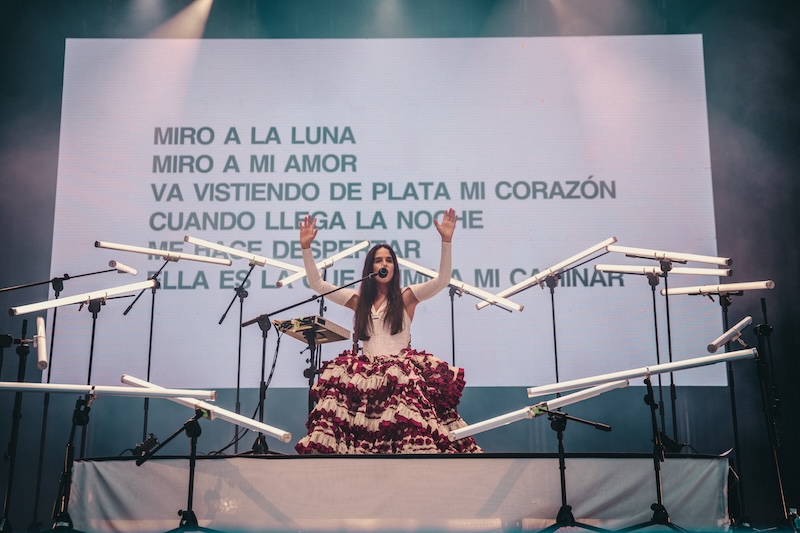
What is it to have your heart in two places? Back in England, after spending part of her childhood in a small mountain village in León, Spain, Nina Cobham was encouraged to publish her music. When her Spanish friends heard those first songs, they jokingly told her: “Oh, you make music for your English family and not for us.” Although she knew they didn’t mean it, she felt the need to sing for them too. “Then, it switched something in my brain and I realized it all made sense. Some lyrics felt more passionate when I said them in Spanish, or more intense,” she told NME. “It made it easier to find the syllables if a phrase didn’t sound right when I sang it in English, and it was also therapeutic to write lyrics in both languages because I journal in both languages. It became easier for me to channel my thoughts.”
Despite her youth, Nina Cobham was already hailed as a revelation two years ago when we introduced her, along with her debut EP and first singles, as “Billie Eilish’s Spanglish Doppelgänger.” Born in Leeds but based in Manchester, she has always had a deep connection to Spanish culture; this indelibly shaped her identity and, of course, her music. This cultural background has allowed her to develop a unique style that fuses alternative pop and R&B with Latin music, singing in both English and Spanish — a choice that reflects her personal history, linked to both countries, and also allows her to connect with a global audience. Since 2019, Nina has released numerous singles and three EPs. “Mejor Contigo (Homesick)” came out last month and continues to explore the nuances of intimate songwriting, including some nostalgic bossa nova vibes.
BIIG PIIG
Jess Smyth took the alias Biig Piig from a local pizza place, following an inside joke with a friend. She was born in Cork, Ireland, but moved to Spain at the age of 4 with her family on medical advice, as the climate there would be better for her brother’s asthma. Eight years later, she returned to Ireland, but reintegrating into the local culture was not going to be easy for her: at the age of 12, she could only read and write in Spanish. At 14, she moved to West London with her family, where she worked at her parents’ pub, but also where her desire to make music was revealed, where she connected with the communities and became passionate about neo-soul and hip hop. At 16, motivated by the underground scene and cultural crossovers, she joined the collective and supergroup NiNE8.
Growing up in London as a teenager was crucial to Biig Piig’s development as an artist. But the influence of Spain on her style and songs is impossible to ignore. “I think with Spain — obviously the Spanish in my music — I find that when I want to write something kind of in secret, I don’t want the person that I’m writing about to understand it I can put it in Spanish and it’s a bit more of an internal thing,” she told Australian magazine 10. “Also, Spanish as a language I feel like there are so many ways you can say things in more of a romantic way but simply. I think if I said it in English it wouldn’t have the same effect.” Last month, her first full-length album, 11:11, came out, following many solo releases (4 EPs between 2018 and 2021, a mixtape in 2023, and tons of singles since 2017).
DAYME AROCENA
There are few voices as expansive, rooted, and genre-defying as that of Daymé Arocena. Born and raised in Havana, this Cuban artist is a classically trained jazz powerhouse who channels the full spectrum of her heritage, Afro-Caribbean rhythms, Santería spirituality, soul, jazz, and funk, into every note she sings. But Daymé’s artistry transcends language. From early in her career, she’s unapologetically moved between Spanish and English, honoring the music that shaped her while carving a space that’s uniquely her own. “Some feelings,” she’s said, “are simply easier to express in English.” It’s a language that shaped the jazz and soul records that guided her formation as a musician so naturally, her own work dances fluidly between both worlds.
This duality comes alive in her albums Nueva Era, Sonocardiogram, and more recently, Alkemi, a luminous, soul-baring journey featuring a collaboration with Vicente Garcia nominated for Latin Grammy Song of the Year. Alkemi is a perfect example of how Daymé threads English and Spanish effortlessly, letting language serve the spirit of the song continuing this exploration, with deep Yoruba undertones and collaborative tracks that stretch beyond genres and borders. Her duality continues to shine through on her latest project, Daymé y Yo, an intimate invitation to feel just Daymé and her piano. Whether she’s invoking ancestral energy or channeling cosmic jazz, Daymé Arocena sings like someone deeply rooted yet boundless—a true bridge between worlds.
NAÏKA
A living example of a global artist, the talented Naïka often defines herself as a citizen of the world: she now lives in Los Angeles but has previously lived on four different continents, including places like Guadeloupe Island, Vanuatu Island, Kenya, Paris, South Africa and Miami. Of course, it’s not just about travelling; she’s also good at languages: English, French, Haitian Creole, a little Spanish and, more recently, some glimpses of Arabic — that’s how she’s been spotted on social media, coached by her boyfriend Saint Levant. Her songbook has always been quite varied. She sings a lot in English, but she often mixes it with French. This is evident in her debut EP, 2020’s Lost in Paradïse, Pt. 1, with that “voila” echoed in the opening track, “Vultures”, or even more clearly in the bilingual song “Big Steps”. Also, on that EP, she pays homage to her Haitian roots by singing the chorus of “African Sun” in Creole. “My goal is to bring people together in different cultures and make people open to understanding a culture they’re not familiar with — and that they may not think they can connect with because it’s so far from what they know,” she told Audiofemme.
Naïka isn’t a new face, not at all, here on Tigre Sounds. We were blown away by her hit single “Sauce”, from 2021’s Lost in Paradïse, Pt. 2. Also from that EP, there are songs that combine English and French lyrics, such as “Ma Chérie” and “Water”. Right after, she released “Belle, Belle!”, a single entirely in French. We continued to marvel at her with “Guava”, an infectious single sung almost entirely in English but with a hypnotic outro in French, included on 2022’s Transitions. “ H2O” also pops up there with a few bilingual verses. Then, in 2023, she again mixed the two languages on the single “Milkman”. The following year, she fully re-emerged on the wave of Afropop and Nigerian R&B with “1+1”, only to reaffirm that trend in 2024 with “6:45”, her latest language-switching single.
SAINT LEVANT
There’s probably a pun on Yves Saint Laurent. Still, the artistic alias of Marwan Abdelhamid alludes to the Mediterranean Levant. This region includes Palestine, in some way symbolizing the vindication of the orientalist fantasies to which the Levant has historically been a victim. Of course, there’s a richer and more complex life story behind Saint Levant. He was born in Jerusalem just a week after the outbreak of the Second Intifada. The son of a Palestinian-Serbian father and a French-Algerian mother, Marwan spent the first seven years of his childhood in the Gaza Strip, until the 2007 battle forced his family to move to Amman, Jordan. He moved to Los Angeles in his late teens to study at the University of California, Santa Barbara. From there, in 2020, he burst onto the scene with two language-blending singles that garnered hundreds of thousands of streams: first was “Jerusalem Freestyle”, followed by the even bigger hit “Nirvana in Gaza”.
Saint Levant’s family story is one of ethnic fusion, enduring harsh exiles, and adapting to other cultures. This empowered him as an artist and largely explains his ability to sing and rap in English, French, and Arabic. On singles like 2022’s “Very Few Friends” and 2023’s “Nails”, Saint Levant raps fluently in whatever comes to him: primarily in English, then quickly adding Arabic words or phrases to blow our minds with a French verse or chorus. A global and multicultural hip-hop blender. In the middle of last year, he finally released his debut album, Deira. The advance single, titled the same as the album, features him singing in Arabic and MC Abdul rapping in English, boosted by a great music video. The other singles that anticipated the album were “5am in Paris” and “Galbi” (he appears with his girlfriend Naïka in the music video). On more recent hits like “Exile” and “DIVA”, both released earlier this year, he mixes the three languages again in different ways.
KAZY LAMBIST
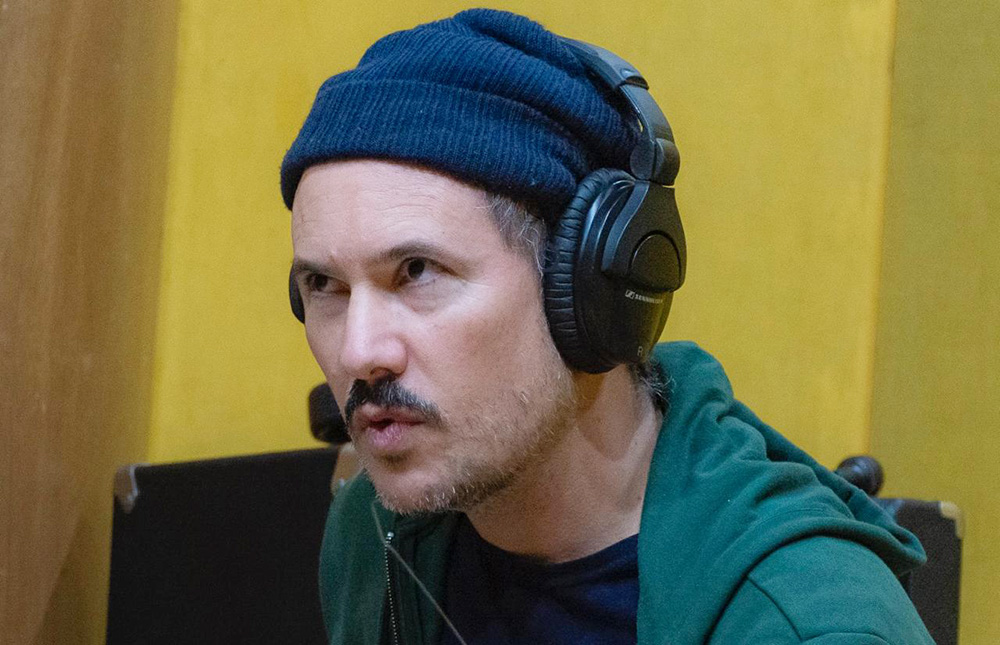
And there it is: another French artist in the electronic music spotlight. We are talking about a legacy of exceptional creators, from yesterday and today, in a wide range of genres, from the ambient of Jean-Michel Jarre to the electropop of Air, from the EDM of DJ Snake to the synth-wave of Kavinsky, not forgetting the leaders of French house and nu-disco, Daft Punk and Justice. Be sure to add Kazy Lambist to this exquisite list, a restless and voracious young talent born Arthur Dubreucq in 1992 in Montpellier, France. A classical pianist as a child and rock guitarist as a teenager, Arthur found his vein in his twenties, stringing together dance electronica and indie vibes, with singles like “Big Fish” and “Doing Yoga”.
From the beginning, all of Kazy Lambist’s songs were sung in English, except for the occasional chorus in French, as in “Tous les jours”. However, the linguistic turn was definitely taken on their second and most recent album, last year’s Moda, including two songs with lyrics in Turkish, “Moda Disko” and “Dünya”. ”I hope it can open people’s curiosity about some things that they are not used to. Like the Turkish language, I think it’s very beautiful,” he told music magazine Saint Audio. “There’s also this poem at the beginning of the album, It’s a poem by Pasolini read by an Italian actress that I appreciate. So I just hope people can get a good feeling of the vibe that we have in the south of France and in the Mediterranean, like some things we share in the Mediterranean world.”
IBEYI
Of course, we weren’t going to overlook Ibeyi. Actually, the Franco-Cuban twin sister duo is more than bilingual. They sing primarily in English, but you can also hear them sing in French and Spanish. They even combine lyrics in Yoruba, the ancient language and native culture of West Africans, including those forcibly brought to Cuba as slaves. There’s a migrant life story that explains their multiculturalism: Liza-Kaindé and Naomi Díaz were born in Paris but spent a small part of their childhood in Havana, while their Cuban father, Angá Díaz, played congas at the Buena Vista Social Club. Upon returning to France, their mother, Maya Dagnino, a renowned Franco-Venezuelan singer, began taking them to a Yoruba choir, where they learned traditional songs. That ancestral music was etched in their bodies and reappeared strongly in 2013 when they created the duo: Ibeyi means “twins” in Yoruba.
Traced and colored with cultural bridges, Liza-Kaindé and Naomi’s life story accurately reflects the different languages they chose when writing their lyrics. They are European, but they also proudly carry their Latin American roots and Yoruba heritage. “We take everything,” said Naomi two years ago, during an exclusive interview for Tigre Sounds, before embarking on her Spell 31 Tour. “We often say that we have allowed ourselves not to choose, which I think is really important. Embrace everything you can. You know, we were born in Paris and we grew up there. So it helped. It’s amazing. France is amazing when it comes to culture. We went to music schools. We learned a lot about music and about culture in general, so we know we’re lucky. But also, you know, our dad is Cuban and that’s part of — a big part of — our heritage, the Yoruba part specifically. However, we never try to force it. I think it’s more when it’s about us that we then put it into a song. We never try to put something Yoruba because we have to. It’s so special that it finds its place when it wants. We take as much as we can, and we’re very proud that we can mix and don’t just have to choose.”
MIDNIGHT GENERATION
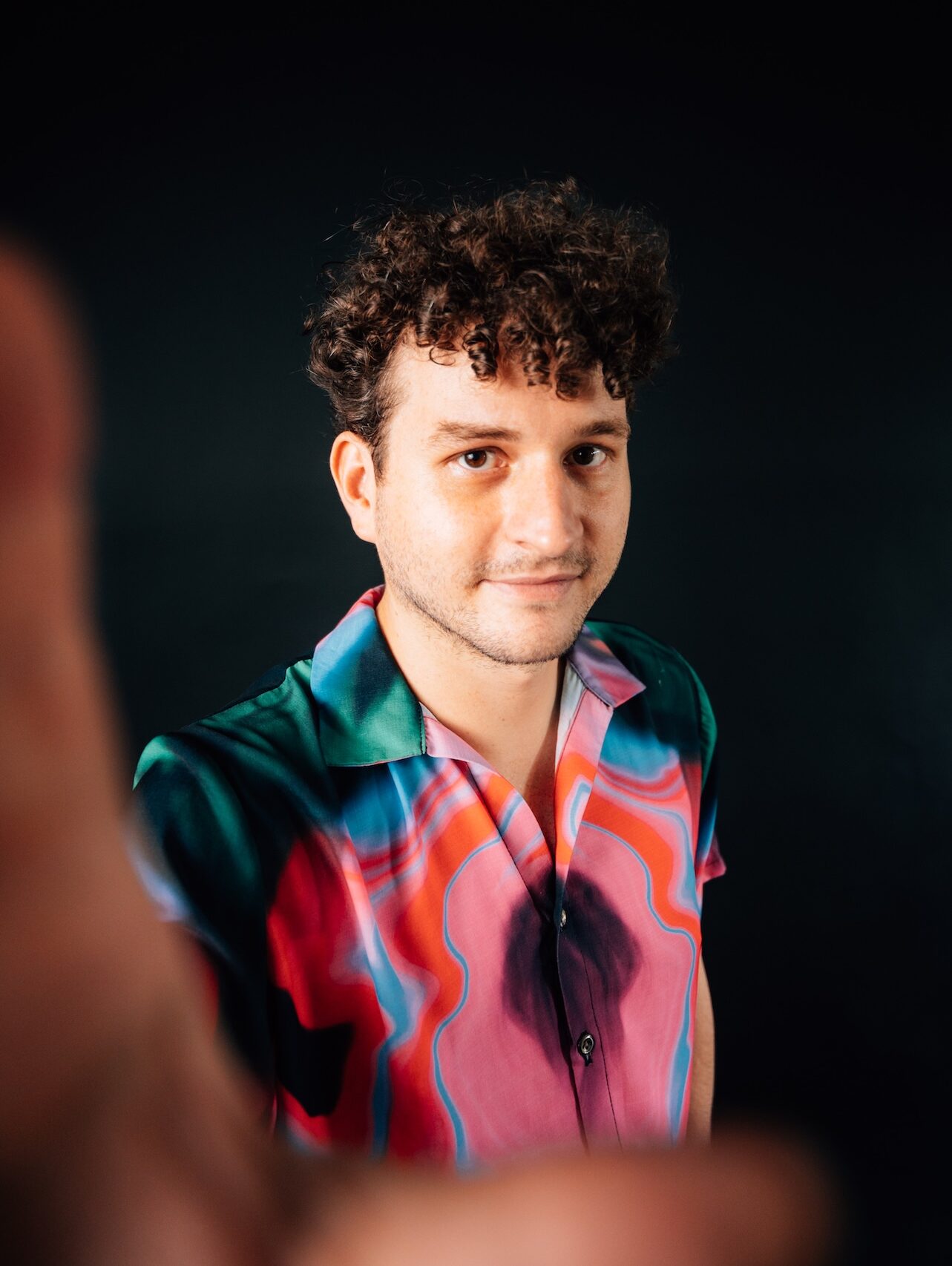
From the high-desert city of Chihuahua, Midnight Generation is rewriting the rules of what Mexican funk can sound like. Led by the magnetic Fernando Mares, the group has carved out an irresistibly eclectic lane that fuses disco, soul, indie dance, and synth-laced funk with a global appeal that’s anything but accidental. Their breakout single, Don’t Wait Up, sent ripples far beyond Mexico, landing them on the radar of international listeners craving that sweet spot between groove and emotion. Though their roots are proudly Mexican, their sound feels borderless and so does their language. Most of their lyrics are in English, not out of trend, but out of instinct. As Mares puts it, the music they make simply flows in English, “it’s often the language that fits the rhythm, the feeling, the funk”, he says.
Though many of their tracks are sung in English, the band is excited to explore Lyrica narratives in their own language as is the case with recent track Tan Cerca. There’s a kind of retro-futurism in what Midnight Generation brings to the table; something nostalgic yet forward-leaning, grounded yet expansive. You can hear echoes of Jamiroquai, Parcels, or Daft Punk, but always with a twist that feels unmistakably their own. Their live shows pulse with energy, sweat, and celebration, pulling crowds into a world where language is secondary to vibe. For bilingual listeners, or anyone who finds home on the dancefloor, Midnight Generation is a band that reminds us that music isn’t just about where you’re from, but how you feel when the bassline hits.
NATALIA DOCO
From a very young age, Natalia Doco has always been a dreamer. Her biggest dreams were to sing on stage and travel around the world. And so, thanks to a frustrating experience on a musical reality show, she decided to pack her bags. First, she went to Mexico to perform in bars. There, thanks to the local music and those popular songs of spite, she found a strength in her voice that she didn’t know. She was ready to be heard, but a new letdown with the industry brought her back to her parents’ house in Buenos Aires. Then she went on the road again, this time to Europe: on her last night in Paris, she met her love and partner, Florian Delavega, who took it upon himself to relaunch her career. He recorded her playing covers of all kinds in different locations and uploaded those videos to YouTube.
Going back and forth, singing a bit of everything, gave Natalia Doco the flexibility to sing in whatever language came her way. She then went on to perform all kinds of covers, in an intimate format, backed almost always only by her voice and guitar. Some of this material ended up on her debut album, 2014’s Mucho Chino, where she can be heard singing in Spanish “La Celestina” by Lhasa, in English “And I Love Her” by The Beatles, and in French “Et Pourtant” by Charles Aznavour. But her bilingual talent took off even more on her second studio album, 2017’s El Buen Gualicho, where she switches from Spanish to French in the same song, sometimes even in the same verse or chorus. After a special break to focus on her motherhood, Natalia is back with a new album, La Sagrada, in 2023.
Cover photo by Melanie Lehmann.